

For over a decade, enterprises believed content scale was a solvable operational problem. Invest in a CMS. Add a DAM. Build a CDP. Hire more writers, reviewers, and localization teams. Scale would follow.
That model is now breaking.
According to Gartner, by 2026, more than 80% of digital experiences will be influenced by AI, yet most organizations still rely on content operating models designed for a fraction of today’s demand. IDC estimates that AI-driven customer experience technologies will attract over $170 billion in global spend by 2027, with content creation and personalization emerging as the fastest-growing segments.
The reality is stark: content demand is growing exponentially, while human capacity scales linearly. AI isn’t just accelerating content creation; it is exposing the structural limits of traditional authoring and personalization models.
The Experience Explosion
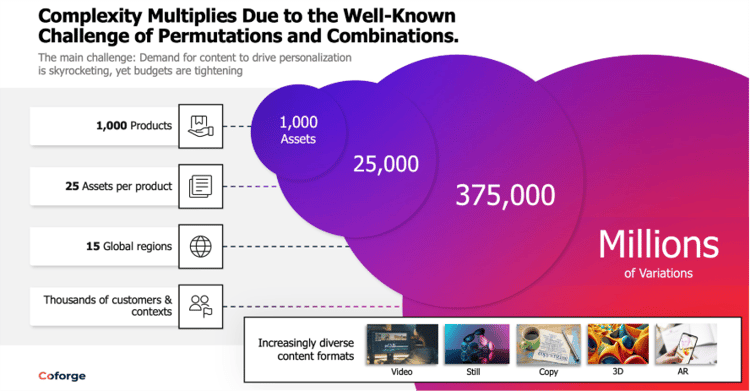
Consider a typical global enterprise scenario:
- 1,000 products
- 25 core content assets per product
- 15 geographic regions
That alone produces 375,000 baseline assets. Add journey stages, behavioral segments, device formats, regulatory variants, A/B testing, and localization nuances, and content volume quickly expands into the millions.
Human-centered workflows collapse under this pressure. Teams fall into survival mode, prioritizing speed over relevance and compliance. Personalization becomes shallow. Content debt accumulates quietly. What was once a growth engine becomes a bottleneck.
AI doesn’t create this complexity. It makes it visible and unavoidable
The Hidden Cost of Not Acting
The most dangerous cost of delaying AI adoption isn’t technology spend. It’s business erosion that never appears on a balance sheet.
Revenue leakage is the first casualty. McKinsey reports that organizations leading in personalization outperform peers by up to 40% in revenue growth. Enterprises relying on static content libraries and rule-based personalization simply cannot react fast enough to capture intent in the moment.
Operational drag is the second. Without AI-driven reuse, tagging, and generation, organizations overspend 25–30% on redundant content creation and rework, according to IDC. More headcount becomes the default answer to a system problem.
Compliance risk rises silently. Manual review processes struggle to keep pace with volume, especially in regulated industries. One outdated disclaimer or misaligned claim can trigger regulatory penalties, forced takedowns, and brand damage, often at a seven-figure cost.
And finally, experience lag becomes visible to customers. As competitors deploy adaptive, AI-generated experiences, laggards see higher bounce rates, lower engagement, and declining trust.
Inaction is not neutral. It compounds.
From Assisted Creation to Autonomous Experience Engineering
Early generative AI tools focused on assistance, helping authors write faster or brainstorm ideas. That phase is already behind us.
Modern AI systems:
- Interpret briefs and intent
- Generate structured, on-brand content
- Adapt tone and messaging by audience, channel, and context
- Optimize continuously based on real-time performance data
Unlike humans, AI does not fatigue, forget, or lose consistency. It operates continuously, at machine scale.
This marks a fundamental shift, from content authoring to experience engineering, where experiences are dynamically generated rather than selected from predefined libraries.
Why Generic LLMs Fall Short in the Enterprise
Public large language models bring speed, but not control.
Enterprises quickly encounter issues such as hallucinations, brand voice drift, regulatory violations, and inconsistent terminology. At scale, these risks are unacceptable.
The next phase of maturity centers on domain-tuned Small Language Models (SLMs) trained on enterprise-specific assets:
- Approved brand vocabulary
- Product catalogs and pricing rules
- Regulatory and legal content
- Industry terminology and metadata
- Historical performance signals
Combined with enterprise embeddings, organizations map structured and unstructured knowledge into a shared semantic layer. Content graphs then define relationships between assets, variants, compliance states, and personalization logic.
The result is not more creativity, but controlled intelligence.
Indicative Solution Architecture: AI for Segmentation and Content Creation
This is where architecture replaces ad hoc experimentation.
No single model can satisfy enterprise needs. Multi agent systems assign specialized roles: audience analysis, copy generation, image generation, critic review, compliance checks, optimization, and publishing.
Our view on Indicative Solution Architecture – AI Model for segmentation and content creation
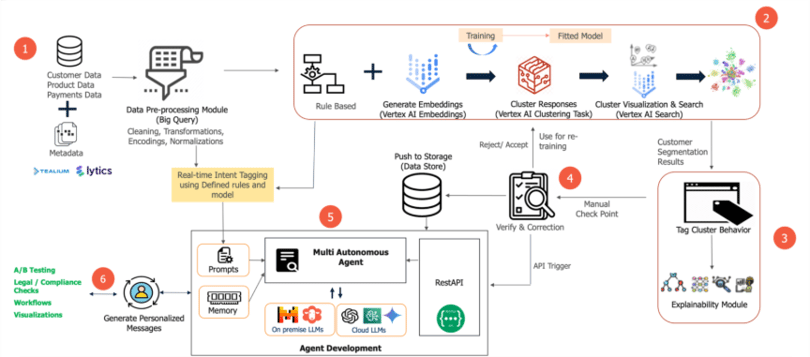
Multi-Agent Systems: Scaling Without Losing Control
No single model can meet enterprise needs.
Modern implementations rely on multi-agent architectures, where specialized agents handle discrete responsibilities:
- Audience and intent analysis
- Copy and creative generation
- Brand and compliance validation
- Performance optimization
- Publishing and orchestration
These agents critique, negotiate, and refine outputs before activation, mirroring human marketing teams, but operating at exponential speed and consistency.
Linear workflows give way to self-improving pipelines.
Human-in-the-Loop Becomes Human-as-Governor
HITL shifts from creating content to governing the system. Humans define constraints, approve exceptions, set confidence thresholds, evaluate sensitive cases, and refine training data.
Gen AI Marketing workflow
- Using the tools and data foundation within the existing MarTech and Data stack
- Create a series of Gen AI agents to support marketers and Ad-Control, with humans in the loop at every stage
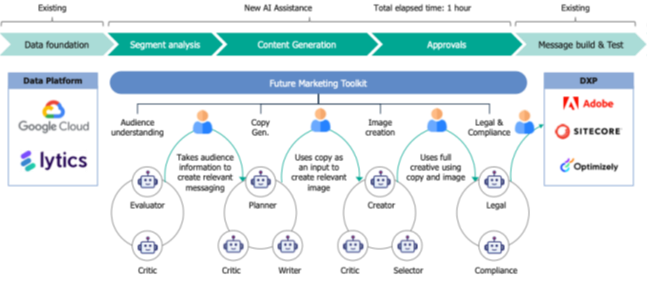
This transforms authoring from labor driven to oversight driven and enables scale from hundreds of assets per month to thousands per day
Infinite Variation Becomes a Competitive Weapon
AI transforms variation from a cost center into a strategic advantage.
Content can now adapt dynamically across:
- Regions and languages
- Journey stages
- Behavioral signals
- Device and channel contexts
- Product lifecycle states
As performance data flows back, content regenerates and improves autonomously. Traditional CMS and DAM platforms strain under this model, accelerating the adoption of automated tagging, semantic versioning, and programmatic publishing.
Personalization becomes continuous, not episodic.
Industry Use Cases: Where Impact Is Already Visible
Retail & E-Commerce
AI generates product descriptions and offers dynamically based on inventory, demand, and customer behavior—reducing campaign launch cycles and increasing conversion rates.
Banking & Financial Services
Domain-tuned AI produces compliant, localized content across products and regions, shortening approval cycles while improving onboarding and cross-sell effectiveness.
Healthcare & Life Sciences
Personalized patient education and engagement content is generated safely at scale, maintaining regulatory alignment while improving adherence and outcomes.
Travel & Hospitality
Real-time journey messaging and offer personalization drive ancillary revenue and improve customer satisfaction across digital touchpoints.
Coforge’s Perspective: Making AI Operable at Enterprise Scale
Coforge views AI as an orchestration layer above existing MarTech investments, not a rip-and-replace exercise.
By combining domain depth, AI platforms, and governance frameworks, Coforge enables enterprises to:
- Deploy domain-tuned SLMs safely
- Implement multi-agent content pipelines
- Govern AI with confidence
- Unlock exponential content velocity
Coforge’s AI-led content and personalization frameworks demonstrate how organizations can move from content bottlenecks to autonomous, governed experience ecosystems, delivering measurable gains in speed, efficiency, and engagement.
Conclusion
AI is not testing the limits of content authoring and personalization; it is shattering them. Content shifts from static assets to programmatic systems, personalization evolves into real-time intelligence, and workflows become autonomous by design. In this new model, humans no longer execute at scale; they govern, guide, and refine the system that does.
Enterprises that act now will define the next decade of digital experience leadership, while those who wait will absorb the hidden costs, quietly, continuously, and competitively. The future of experience is autonomous, and the window to lead it is open now.

Sandeep Uppal is a seasoned Customer Experience Evangelist and currently heads the Experience HBU at Coforge, where he leads the charge in delivering innovative and transformative digital experiences. With over 26 years of expertise in Digital Transformation and Experience Management, Sandeep has held leadership roles at HCLTech, IBM, and Wipro, driving impactful strategies that align technology with customer-centric design.
At Coforge, Sandeep specializes in crafting strategic roadmaps and delivering headless omnichannel solutions, data-driven marketing, and GenAI-powered personalization. His focus is on enabling businesses to create scalable, differentiated experiences for customers, partners, and employees, ensuring business success through meaningful and measurable outcomes.
Through his work, Sandeep continues to champion the role of digital ecosystems in shaping the future of experience-driven transformation.
Related reads


About Coforge
We are a global digital services and solutions provider, who leverage emerging technologies and deep domain expertise to deliver real-world business impact for our clients. A focus on very select industries, a detailed understanding of the underlying processes of those industries, and partnerships with leading platforms provide us with a distinct perspective. We lead with our product engineering approach and leverage Cloud, Data, Integration, and Automation technologies to transform client businesses into intelligent, high-growth enterprises. Our proprietary platforms power critical business processes across our core verticals. We are located in 23 countries with 30 delivery centers across nine countries.