
Executive Summary
Retailers have never owned more data about their customers, and yet many still grapple with how to turn it into profitable, repeatable outcomes.
The last 10 years have heard the promises of generic Customer Data Platforms (CDPs) for “a single view of the customer” or omnichannel personalization. Most retail brands are now using some kind of CDP. They stitch together data sources, create rudimentary segments, launch campaigns … and then it stalls.
It’s not just a technology maturity issue or project delivery problem. It is about fit for purpose.
Retail is more than just “transactions and events.” It is:
- Baskets, assortments, and planograms
- Promotions, discount ladders and markdown risk
- Store types, inventory constraints and labour costs
- Category roles, private brands and margin squeeze
A horizontal CDP that considers a purchase as “one more event in a stream” cannot really reason about:
- Whether a basket signifies distressed buying or indulgence
- The volume and margin trade-off for a promotion
- The operational constraint where a product is out of stock in one store and overstocked in another
What is clear over the next five years is a move away from generic CDPs to verticalized, retail-first CDPs – platforms that are built around retail entities, journeys and KPIs from day one.
This whitepaper outlines:
- Why many of today’s CDPs hit the skids in retail
- What a retail CDP is and what makes a verticalized retail CDP fundamentally different
- How personalization, merchandising and economics will change on these platforms
- A realistic roadmap for retailers and their technology partners to get started
For CXOs, the implications are simple: stop using your CDP as a marketing add-on. Think of it as the decision brain for your retail business – optimized for your categories, customers and channels.
Why Retail Needs a New CDP Paradigm
The changing retail reality
Most retail boards face much of the same set of tensions:
- Channel mix has exploded. Store, web, app, marketplaces, social commerce, quick-commerce (sub-one-hour delivery), call centres — often all serving the same customer in the same week.
- Loyalty is fragile. Customers have low switching costs; they move quickly if someone else offers better value, greater convenience, or a smoother experience.
- Margins are thin. Higher acquisition costs, aggressive discounting, and supply-chain disruption leave very little room for broad-brush promotions.
- Data is fragmented. POS, ecommerce, apps, loyalty programmes, CRM tools, ad platforms, payment providers, marketplaces, and third-party data all generate signals that rarely fit into a single, canonical structure.
In this environment, retailers need real-time, precise decisions at the edge:
- What to show this customer right now
- What price or offer to present
- How to fulfil the order profitably, given store and inventory constraints
In theory, CDPs should be ideal for this. In reality, most generic implementations fall short.
Where horizontal CDPs hit their limits
Most generic CDPs, used “off the shelf,” are reasonably good at:
- Ingesting batch and streaming data
- Resolving identities
- Building and exporting segments
- Passing those segments to downstream marketing tools
But they fall short on retail-specific needs, such as:
- Modelling SKU, category, and brand hierarchies with the nuance merchandisers expect
- Respecting real-time store-level availability and fulfilment constraints
- Analysing basket structures rather than isolated line items (attach, upsell, substitutes, complements)
- Measuring results in terms of incremental margin, stock turn, and markdown reduction instead of stopping at engagement metrics
The result can sound impressive in a demo, a shiny “customer 360”, and some campaigns, but has limited impact on the P&L.
The answer is not simply “add more AI” or “plug in more connectors.” What’s required is a CDP that starts from the retail industry’s data model and economics, not from a generic event stream.
Why Horizontal CDPs Plateau in Retail
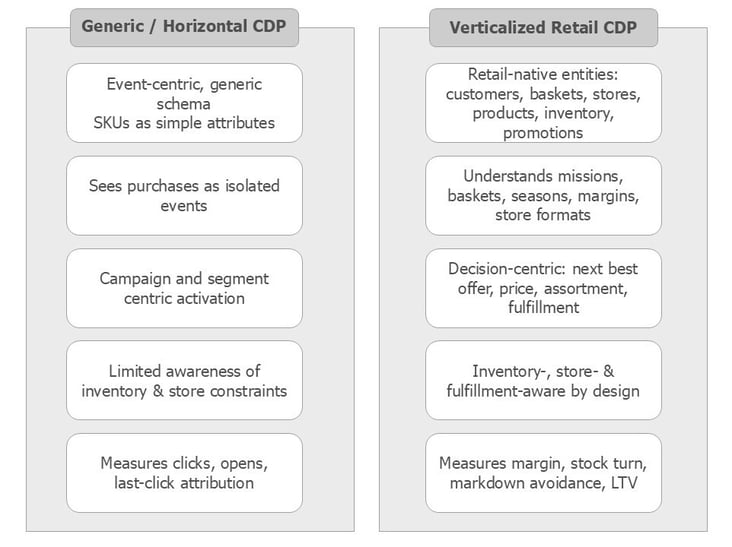
Horizontal CDPs can connect data and run campaigns, but they rarely encode retail’s economics and constraints. Verticalized CDPs start from retail’s data model, journeys, and KPIs.
What Is a Verticalized Retail CDP?
A verticalized retail CDP, a customer data platform that is purpose-built for retailers, not just “made to fit” them.
It typically:
- Uses a retail-native data model as its foundation rather than a generic event schema
- Ships with out-of-the-box connectors and business logic for retail systems (POS, OMS, ecommerce, loyalty, inventory, etc.)
- Bakes retail-specific decisioning and analytics into the application – from replenishment propensity to store allocation signals
- Maps directly to retail KPIs such as margin, stock turn, basket size, visit frequency, and churn
In simple terms: don’t ask your teams to teach a horizontal CDP how to think like a retailer; adopt a platform that already understands products, stores, baskets, promotions, seasons, and channels.
Design principles for a retail-first CDP
There are several common principles that most successful verticalized retail CDPs share:
- Domain-first schema. The core data model explicitly includes customers, households, products, categories, baskets, stores/locations, channels, promotions, orders, returns, and inventory.
- Omnichannel by design. Signals from store, ecommerce, app, contact centre, and marketplaces are all first-class citizens – not afterthoughts.
- Decision brain vs. execution arms. The CDP focuses on deciding who to target, with what, and when. Commerce engines, ESPs, app push platforms and ad platforms execute those decisions.
- Closed-loop measurement. Every decision is tied back to retail performance – sales, margin, returns, and lifetime value – not just clicks and opens.
Core Capabilities of a Verticalized Retail CDP
A retail-native data model
Core Entities in a Retail-Native CDP Data Model
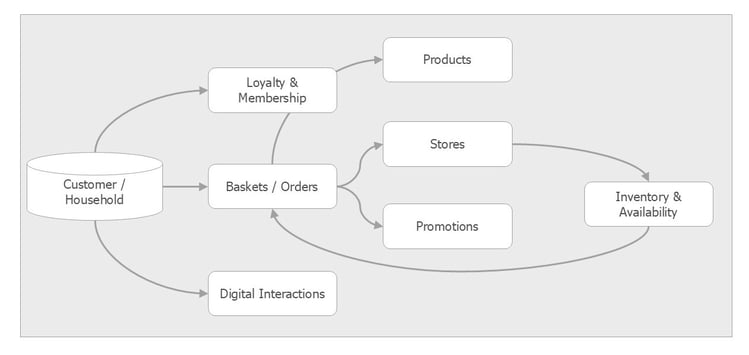
A verticalized CDP organizes data around familiar retail entities – customers, baskets, stores, products, inventory, and promotions – rather than a flat stream of generic events.
Rather than everything being a generic “event”, a verticalized CDP organizes data in terms that business users can relate to straight away.
Product and assortment
- SKU and variant
- Category tree and sub-categories
- Characteristics such as size, colour, design, season, brand, pack type, or nutrition
Store and fulfilment
- Store formats and clusters
- Regions and catchment areas
- Click-and-collect locations, dark stores and warehouses
Baskets and orders
- Multi-item baskets
- Line-level discounts and promotions
- Tender types, cancellations and returns
Promotions
- Campaigns and offer formats (BOGO, % off, bundles, multi-buys)
- Eligibility rules and caps
- Redemption tracking across channels
Loyalty & membership
- Tiers and points
- Benefits and vouchers
- Household relationships and shared wallets
This structure enables you to answer questions that actually matter in retail, such as:
- “Among customers who buy super-premium private labels, which ones only buy on promotion and which buy at full price?”
- “Which areas or categories drive first-purchase returns and put new customers at risk?”
- “What are the attach rates of core products to their accessories, by store cluster and channel?”
Omnichannel identity and consent, the retail way
In a typical retailer, different touchpoints see different slices of the same person:
- A store customer paying cash and appearing anonymous
- An app user who is logged in and browsing but not purchasing
- A marketplace buyer whose identity is partially hidden by the platform
- A loyalty member who sometimes shops in-store and sometimes online
A verticalized CDP focuses on:
- Joining identities by linking loyalty ID, email, phone number, device ID, payment token, and sometimes household relationships
- Managing consent and preferences by channel and purpose (service, profiling, personalisation, third-party use)
- Constructing household-level or occasion-level views where they are meaningful – for example, family grocery baskets vs. individual fashion purchases
When done well, this provides retailers with a solid identity spine — without taking liberties with customer trust or regulatory compliance.
Retail-specific AI and decisioning
The Retail CDP as a Decision Brain
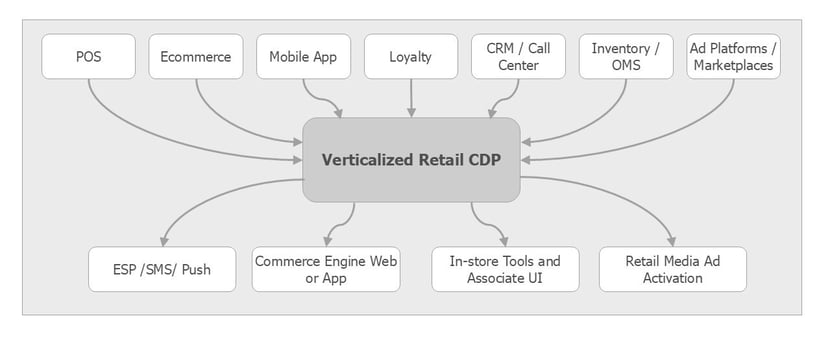
A verticalized retail CDP acts as the decision brain – ingesting signals from core systems, deciding who to target with what, and orchestrating execution across channels
Instead of generic “propensity to buy,” a retail CDP is more likely to focus on questions such as:
- What new category or brand is this customer most likely to explore next?
- Is their basket value rising, flat, or at risk of downgrading?
- What is the likelihood of return for a specific product or combination of products?
- How discount-sensitive is this customer compared to full price?
- How likely are they to try new services such as subscriptions, same-day delivery, or buy-now-pay-later?
These signals are then used to drive action policies such as:
- Offering a small accessory discount when a customer buys a high-margin hero product at full price
- Triggering replenishment reminders only when the product is in stock in the customer’s preferred store or region
- Suppressing promotions for customers who consistently buy at full price and show low churn risk
The aim is to make the CDP decision-centric, not just “segment-centric.”
Closed-loop experimentation and measurement
Retail leaders have no shortage of reports. What they really want is evidence that personalization and CDP investments move the numbers that matter.
A verticalized CDP enables this by:
- Treating every campaign or decision as an experiment (A/B or multivariate)
- Tying results to incremental sales and margin, not just top-line revenue
- Measuring impact on stock turn, markdowns, basket size, category penetration, and frequency
- Tracking long-term effects via lifetime value and movement across loyalty tiers
Over time, the platform becomes a learning system for the entire commercial organisation – not just a tool for marketing.
How Verticalized CDPs Will Redefine Personalization and Commerce
From generic personalization to retail-aware experiences
From Customer Mission to Retail-Aware Personalization
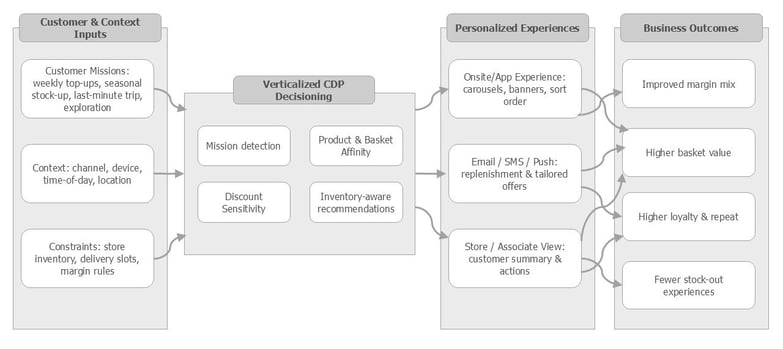
Retail-aware personalization recognizes the customer’s mission, the retail context, and operational constraints – and then tailors experiences across digital and store touchpoints.
A lot of retailers right now are still using a familiar, basic toolkit:
- Primitive “recommended for you” carousels based on simple co-view / co-purchase
- One-size-fits-all cart abandonment emails
- Batch promotions sent to broad audiences
A verticalized CDP allows a much more nuanced approach.
Mission-based personalization
Rather than treating every visit the same, the platform differentiates missions:
- Weekly grocery top-ups
- Big seasonal stock-ups
- Last-minute “I forgot” trips
- Exploratory browsing vs. task-oriented visits
Deals, recommendations, and product messages automatically adapt to the mission.
Assortment- and inventory-aware experiences
Recommendations and offers are grounded in real operational context:
- What’s actually in stock in the customer’s preferred store or region
- Substitutes that make sense for both brand and margin
- Mission-aligned complementary products (for example, a meal kit with sides and beverages)
Channel-aware journeys
If a shopper browses on the app and later walks into a store, the CDP can surface key signals:
- Wishlisted or favourited products
- Abandoned categories
- Recent service issues
Store associates, apps, and contact centres can all deliver the same level of insight, leveraging a shared understanding of the customer.
2 More effective merchandising and pricing decisions
CDP data is used directly to drive merchandising and pricing when it sits on a retail-native model.
Retailers can:
- Cluster micro-segments by taste, price sensitivity, and promotion response
- Align markdowns with promotion depth, sell-through, and margin
- Get proactive on merchandising by understanding which items attract new customers, repeat customers, or high-value baskets
The CDP effectively transforms from a “marketing database” into a commercial decision engine.
3 Enhanced store operations and associate enablement
Employees on the shop floor often work with only local context and limited information. A verticalized CDP can:
- Highlight priority customers who are likely to visit today (based on appointments, app activity, or geo signals)
- Trigger “save the sale” alerts when high-value customers face stock-outs, suggesting similar items or ship-from-store options
- Provide simple dashboards of customer preferences, sensitivities, and history that associates can access on the shop floor
This typically shows up in three key metrics: conversion, basket size, and customer satisfaction scores.
New sources of revenue and partnership opportunity
For retailers exploring retail media or data/partner monetisation, a verticalized CDP is an essential foundation.
It enables:
- Retail channels (onsite, app, email, offsite media) where brands can reach high-value audiences in a privacy-safe way
- Transparent incrementality measurement for brand campaigns, not just ad impressions
- Governance and consent frameworks that regulators and customers can trust
In other words, the CDP becomes the “engine room” powering retail media networks and data partnerships.
Today vs. Five Years from Now: A Maturity View
The Four Stages of Retail CDP Maturity
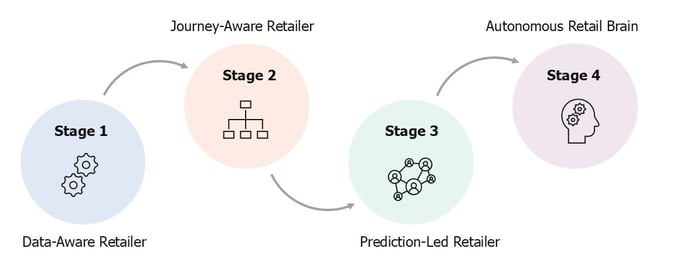
Most retailers have started their CDP journey but remain in the data- and journey-aware stages. The next frontier is an autonomous, verticalized retail brain that supports marketing, merchandising, and operations.
There are four phases you can use as a way to think about the next five years of CDP maturity. The first two already describe where many retailers are today.
- Data-Aware Retailer (where many are today)
- Different datasets plumbed into a simple CDP
- Segments primarily driven by the marketing team
- Activation focused on themed campaigns and communication
- Measurement centred on clicks, opens, and last-click attribution
- Journey-Aware Retailer
- User journeys mapped across store, web, app, and service experiences
- Triggered communications for key events (cart abandonment, replenishment, onboarding)
- Improved use of first-party data and consents
- Prediction-Led Retailer
- Embedded AI models predicting churn, propensity, next best offer, and return risk
- Consistent, relevant experiences across channels (site, app, store, media)
- Marketing and merchandising both using CDP insights as part of day to day decisions
- Autonomous Retail Brain (five-year horizon)
- The verticalized CDP becomes the central decision system for marketing, merchandising, and operations
- Closed-loop learning optimises campaigns, offers, and assortment elements within agreed guardrails
- Generative content and creative variants supports micro-segments level personalization
Stage four does not remove human control. It shifts human effort to where it matters most: setting strategy, guardrails, and objectives, while the platform handles day-to-day tuning.
How Retailers and Technology Partners Should Prepare
A Pragmatic Day Verticalized CDP Roadmap
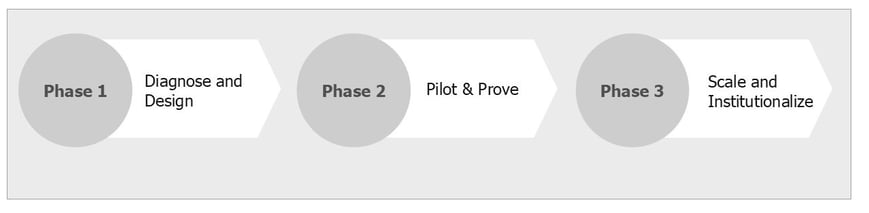
A good roadmap helps retailers move from strategy slides to live journeys and measurable impact – without trying to “boil the ocean.”
Get the foundations right
Rather than racing after the bleeding edge, the vast majority of retailers will do well to reset their fundamentals:
- Rationalise data sources. Determine which are your “source of truth” systems for customer, product, store, inventory, and order data.
- Define a retail data model. Whether you’re using a vendor’s model or developing your own, make sure it reflects your categories, channels, and KPIs.
- Strengthen identity and consent. Build a privacy-by-design framework that withstands regulatory scrutiny and maintains customer trust.
Without this foundation, even the best-executed verticalized CDP will struggle to deliver.
Link CDP objectives to business results
CDP initiatives typically fail when they start with technology and only later look for business value. Instead:
- Anchor CDP investment to a small set of clear objectives, for example:
- Increase repeat purchase rate by X%
- Improve gross margin by Y% through smarter promotions
- Reduce return or exchange rates in specific categories
- Grow adoption of subscription and/or membership programmes
- Define quantifiable KPIs and put them on dashboards that leadership actually reviews.
If the CDP cannot demonstrate movement on these dials, it’s a signal to re-scope or change approach.
Select the appropriate operating model
Vertical CDPs cut across traditional organisational silos. A workable model usually includes:
- Marketing and CRM to define journeys, offers, and messages
- Data and analytics to build and maintain models, and measure impact
- Merchandising and pricing to embed CDP insights into commercial decisions
- IT and architecture to scale, secure, and integrate with core systems
Many retailers formalise this into a Customer Decisioning or Personalization Centre of Excellence (CoE) that owns the agenda end to end.
Partner intelligently
Very few retailers will build a vertically integrated CDP from scratch. Common paths include:
- Adopting a vendor platform that comes with retail templates, connectors, and best practices
- Building a composable stack using a cloud data platform, decision engines, and retail accelerators
- Partnering with specialist system integrators who bring pre-built schemas, models, and reference use cases for segments such as grocery, fashion, or specialty retail
The “right” answer depends on where you are today, your investment appetite, and your internal capabilities. What matters is that a retail lens stays central in every decision.
A Practical Roadmap
To break out of never-ending strategy cycles, many CXOs crave a clear 90–180 day path.
Diagnose and design
- Review current data, tools, and use cases – what is working, what is stalled, and where the gaps are
- Select 2–3 priority journeys (for example: onboarding, replenishment, high-value churn risk)
- Outline a target retail data model and a high-level architecture for the verticalized CDP
Next is Pilot and prove
- Ingest data from core source systems: POS / ecommerce, loyalty, product catalogue, promotions
- Implement identity resolution and basic consent handling
- Build 1–2 pilot journeys powered by the CDP, such as:
- Replenishment journeys across email and app
- Targeted offers for customers at high churn risk
- Quantify impact on margin, visit frequency, basket size, and returns
Next would be to Scale and institutionalise
- Expand to additional channels (app personalisation, onsite recommendations, paid media, store tools)
- Incorporate more advanced models (churn, product affinity, discount sensitivity)
- Establish governance, roles, and processes for experimentation and decisioning
- Create a multi-year roadmap to progressively realise the “autonomous retail brain” vision
The goal is not to “boil the ocean,” but to build momentum with visible wins and a clear direction.
Conclusion
In a few years, it will no longer be a differentiator simply to “have a CDP.”
Most serious retailers will have one. The competitive edge will lie in how that CDP is designed and used.
Retailers that treat their CDP as a retail-native decision engine – integrated with products, stores, pricing, and operations – will have a clear advantage over those who see it as just another marketing database.
Verticalized retail CDPs offer a practical path forward. They enable:
- More relevant, profitable personalization
- Better data to drive merchandising and pricing decisions
- Improved store experiences and stronger associate empowerment
- Expansion of retail media and partnerships as new revenue streams
For CXOs, the next move is less about tools and more about intent:
- Be explicit about where the CDP needs to move the dial
- Demand retail-oriented capabilities and data models
- Hold teams accountable for measurable business results
When done well, a verticalized CDP becomes more than a campaign engine.
It serves as the digital brain for how your retail business learns, decides, and grows.

Anant Singh is the Practice Director at Coforge, where he leads strategic initiatives focused on AI-driven customer experience, Customer Data Platforms (CDP), and real-time personalization at scale. With deep expertise in the Adobe Experience Cloud ecosystem, including Adobe Experience Platform (AEP), RTCDP, Customer Journey Analytics (CJA), Adobe Journey Optimizer (AJO), and Adobe Target, he architects enterprise-grade digital experience solutions that help global organizations unlock the value of their customer data.
His work focuses on bridging data, AI, and marketing orchestration to create personalized, context-aware customer journeys that drive measurable business outcomes.
Known for combining deep technical architecture with strategic CX vision, Anant partners with global enterprises to build scalable personalization frameworks, accelerate CDP adoption, and operationalize AI-powered decisioning across digital ecosystems.