

Abstract
Indian farmers feed one of the world’s largest populations, yet remain highly vulnerable to climate volatility, income instability, and systemic inefficiencies in crop insurance. Despite government subsidies and policy intent, crop insurance adoption remains low due to fragmented processes, limited awareness, delayed claims, and operational challenges faced by insurers and administrators alike. This white paper proposes the concept of a National AI-Powered Crop Insurance Exchange (NCIE) - a digital public infrastructure designed to modernize India’s crop insurance ecosystem. Inspired by platforms such as UPI and Aadhaar, NCIE leverages AI, satellite intelligence, and real-time data to enable seamless enrolment, predictive risk assessment, and rapid, transparent claim settlement. By aligning the needs of farmers, insurers, and government agencies, the proposed exchange aims to make crop insurance scalable, sustainable, and trustworthy - strengthening rural resilience, safeguarding livelihoods, and reinforcing India’s food security for the future.
The Need for a Modern Crop Insurance Infrastructure
Indian farmers form the backbone of the nation’s food security, sustaining nearly 1.4 billion people. Yet they remain exposed to risks beyond their control. Unpredictable weather patterns damage crops, power shortages interrupt irrigation, and limited access to pesticides and inputs continue to drive up costs, steadily eroding farm incomes. When crops fail, the impact is immediate and devastating: livelihoods vanish, debts accumulate, and families are pushed into financial distress. This cycle has persisted for decades.
At the same time, awareness and adoption of crop insurance remain low. Many farmers are unclear about eligibility and coverage, while long claim settlement timelines have weakened trust in the system. Insurers, too, approach crop insurance cautiously, viewing it as complex, operationally intensive, and financially unsustainable.
Despite policy reforms and government subsidies, agriculture remains perceived as a high-risk occupation. The gap is clear. Farmers need simple, reliable protection, insurers require viable, scalable models, and India needs a transparent, modern insurance infrastructure that serves all stakeholders.
This white paper presents the concept of a national AI-powered Crop Insurance Exchange, backed by IRDAI - an intelligent, digital-first platform designed to transform crop insurance from a slow, paper-driven process into a fast, secure, and trustworthy ecosystem. It outlines why such an exchange is essential, how it differs from existing systems such as NCIP, and how AI-led architecture can address deep-rooted challenges to truly safeguard India’s farmers.
Challenges in Today’s Crop Insurance Ecosystem
Climate Volatility
Weather patterns have become increasingly erratic, far exceeding historical norms. Farmers now contend with delayed monsoons, flash floods, sudden droughts, heatwaves, and unseasonal rainfall, often within the same crop cycle. These climate disruptions result in annual losses exceeding $10 billion for India’s agricultural sector, forcing farmers to operate under extreme uncertainty every season.
Income Instability and Financial Stress
Indian agriculture remains highly vulnerable due to its dependence on one or two primary crops, seasonal earnings, rising input costs, low price realization, and heavy reliance on credit. A single crop failure can destabilize an entire household, triggering debt cycles and long-term financial distress.
Limited Access to Reliable Information
Despite India’s digital-first progress, many farmers continue to rely on informal channels for weather forecasts, crop advisories, market prices, and insurance-related information. Persistent digital literacy gaps in rural regions make complex portals and paper-heavy processes difficult to navigate, limiting effective participation.
Low Crop Insurance Penetration Despite Subsidies
Only about 30% of India’s cropped area is insured, even with substantial government support. Low adoption stems not from lack of interest, but from processes that are confusing, inaccessible, slow, and lacking trust. With global agricultural insurance already a $40+ billion market, India has a significant opportunity to lead, provided its insurance infrastructure is modernized.
Gaps and Key Findings
Today, crop insurance in India sits at the intersection of farmer challenges, insurer constraints, and systemic operational inefficiencies, preventing the ecosystem from functioning effectively at scale.
- The Farmer’s Perspective
Farmers continue to face significant barriers related to awareness, access, and trust. Insurance schemes are often poorly communicated, enrolment timelines are unclear, and application processes demand multiple documents and complex digital interactions. Complicated portals, paper-heavy workflows, and fear of claim rejection further discourage participation, placing the burden squarely on the farmer at every stage. - The Insurer’s Perspective
For insurers, crop insurance poses substantial risks, costs, and operational challenges. High expenses associated with manual field surveys, unpredictable post-disaster claim volumes, limited availability of granular risk data, small premium pools, and exposure to fraudulent claims make profitability difficult. Prolonged crop cutting experiments (typically 30–90 days) and manual document verification add to delays and costs. In essence, insurers struggle to scale when risk consistently outweighs returns. - The Government’s Perspective
Despite strong policy intent, administrators face fragmented state-level systems, inconsistent data standards, delayed CCE reports, slow claim settlements, and challenges in subsidy accountability. The absence of real-time, national-level data intelligence limits effective oversight and rapid decision-making. - Limitations of the Existing NCIP Portal
While the NCIP portal serves as a robust administrative backbone for PMFBY, it was not designed to function as an AI-driven, real-time, multi-insurer insurance ecosystem capable of addressing today’s scale, speed, and transparency requirements.
Introducing the National Crop Insurance Exchange (NCIE)
India has successfully transformed critical systems at scale - payments through UPI, identity through Aadhaar, digital commerce through ONDC, and document trust through DigiLocker. Inspired by these landmark digital public infrastructures, the National Crop Insurance Exchange (NCIE) extends the same principles of simplicity, scale, and intelligence to crop insurance.
NCIE is not merely a website or portal; it is a national, AI-powered platform designed to unify the crop insurance ecosystem. It connects all insurers, supports every crop, enables AI-driven transparency, facilitates real-time data exchange, and standardizes end-to-end workflows, ensuring faster, fairer protection for farmers.
Designed as a neutral platform backed by IRDAI, NCIE establishes a common set of rules and data standards for insurers, state governments, banks, and farmers alike. Going beyond existing systems, NCIE functions as a foundational digital public infrastructure, leveraging NCIP within a broader, intelligence-led ecosystem to deliver trust, efficiency, and scalability across the entire value chain.
Architectural Pillars of the AI-Powered Exchange
The National Crop Insurance Exchange is a centralized digital ecosystem that connects agricultural stakeholders such as insurers, banks, farmers, and governments under a unified ecosystem. It enables seamless integration of Agri services to farmers. The following diagram provides a bird’s-eye view of the overall solution before we deep-dive into the solution tenets.
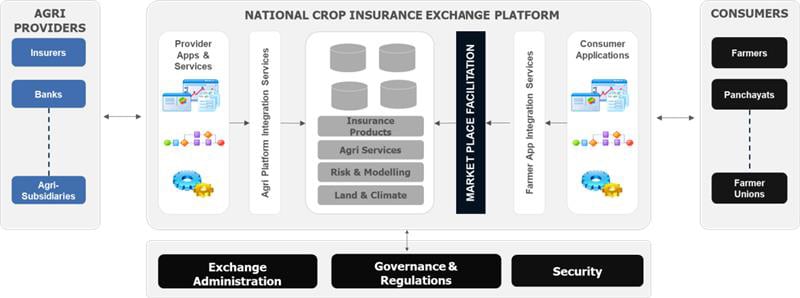
In the current context, the AI-Powered Crop Insurance Exchange is built on four strong architectural pillars designed to solve India’s deepest crop insurance challenges.
Pillar 1: Intelligent Farmer Awareness Engine
We must build a Smart Communication with a simple behaviour tone without complex apps. Provide simple, direct, and timely updates.
Core Capabilities
- WhatsApp and SMS alerts
- Regional-language voice bots
- Crop-specific advisories
- Weather-based warnings
- Enrolment reminders
- Insurance explanation in simple language
Architecture Components
- Multilingual NLP engine
- Content generator tuned for rural vocabulary
- WhatsApp Cloud API connectors
- Weather data ingestion pipelines
- Farmer persona models for personalization
Impact
- Around 2–3x increase in farmer enrolment
- Reduction in information gaps
- No missing deadlines
Precisely, we are turning the awareness campaign from a pull model to a push model.
Pillar 2: Seamless Enrolment and Identity Integration
The system should auto-detect identity, land & crop, and facilitate enrolment. It should be as easy as UPI onboarding.
Core Capabilities
- Aadhaar e-KYC / Face-KYC
- Automatic land record retrieval from state databases
- Satellite crop detection (NDVI, EVI, crop masks)
- Pre-filled enrolment forms
- Subsidy calculation
- Single-click confirmation
Architecture Components
- Land Record API Gateway
- Aadhaar KYC microservice
- Satellite ingestion + crop classification model
- Enrolment Decision Engine
- Multi-insurer policy catalogue
Impact
- Enrolment time reduces from 2– 3 hours → under
- Removes middlemen dependency
A farmer who has never used an app can still enrol via a voice bot.
Pillar 3: AI-Driven Risk Intelligence and Crop Monitoring
Leverage AI along with Remote Sensing technology and apply Predictive Models, which would help in making crop insurance financially sustainable for insurers.
Core Capabilities
- Farm-level risk scoring
- Yield predictions using Machine Learning
- Weather-index risk models
- Soil moisture and vegetation analysis
- Pest outbreak prediction
- Actuarial support for fair pricing
Architecture Components
- Satellite Data Lake
- (Landsat, Sentinel, ISRO)
- Weather Data Integration (IMD + private APIs)
- Crop Health ML Models
- Risk Scoring Engine
- Actuarial Pricing Microservice
Impact
- Risk Predictability can be easily increased up to 30-40%
- Also, a reduction in fraudulent claims
This pillar would build insurer confidence to scale participation.
Pillar 4: Automated and Transparent Claim Settlement
Reduce the claims processing time from 90-180 days to under 72 hours (at least for eligible cases) by automatically triggering, capturing evidence, and enabling transparency through AI. The following table provides the approach:
Core Capabilities
- Satellite-based damage assessment
- Drone-as-a-service integration
- Automatic claim triggers (rainfall, temperature, flood thresholds)
- AI-driven damage quantification
- Digital rules engine for approvals
- Direct benefit transfer to farmer accounts
Architecture Components
- Drone Imaging Pipeline
- Crop Loss Detection Models
- Weather Index Trigger Engine
- Claim Rules Workflow
- Direct Benefit Transfer Payment Gateway Integration
Impact
- Claim TAT reduced from months to days
- Transparent, evidence-backed decisions
- Rebuilding trust in the insurance ecosystem
Impact on Farmers, Insurers, and Government
The Exchange would create a multilayered impact across stakeholders:
Farmers
- Simple enrolment
- Clear awareness
- Predictable payouts
- Reduced anxiety
- Higher confidence to invest in better inputs
- Fewer middleman dependencies
Insurers
- AI risk scoring reduces exposure
- Automated Workflows reduce costs
- Satellite evidence reduces fraud
- Marketplace model expands business
- Standardized compliance improves efficiency
Government
- Real-time nationwide risk visibility
- Data-driven subsidy planning
- Fast disaster response
- Accurate monitoring of agricultural distress
- Improved adoption across states
Rural Economy
- Reduction in farmer suicides
- Improved rural credit health
- Higher agricultural productivity
- Stronger climate resilience
- Stable rural consumption
To summarize, NCIE would meet the following goals:
- Farmers finally receive support when they need it.
- Crop insurance becomes viable, scalable, and transparent.
- This aligns with India’s DPI (Digital Public Infrastructure) vision.
- A protected farmer leads to a stronger rural economy.
Future Extensions: Beyond Insurance Toward a Unified Agri-Risk Platform
With further evolution, this platform can expand into a comprehensive marketplace for the agricultural ecosystem. Built on a strong data foundation encompassing land records, crop intelligence, weather models, and AI-driven risk scoring, the exchange can enable adjacent capabilities such as farmer credit scoring, pre-approved agricultural loans, integration with commodity markets and price hedging, subsidy distribution, climate risk analytics, parametric micro-insurance products, and a data exchange layer to support research and innovation. Together, these extensions can unlock a holistic agricultural risk and financial intelligence platform for India.
Conclusion: Building Trust, Resilience, and Agricultural Security
Crop insurance is intended to safeguard farmers, yet the existing model continues to struggle with limited awareness, restricted access, low trust, and significant operational inefficiencies. The proposed AI-powered Crop Insurance Exchange redefines this narrative. It goes beyond modernizing insurance processes to reinforce India’s food security and rural resilience. By delivering timely protection, transparency, and fairness, the exchange supports farming families when they need it most and helps build a future where no farmer faces uncertainty alone.
About the Author

A seasoned digital transformation leader, Naveen Kumar Patha has led large-scale modernization across Cloud, AI, modern engineering, and enterprise operating models. In Engineering, he drives strategic transformation for global enterprises by unifying architecture, delivery, and operations. He builds scalable, cloud-native, AI-enabled ecosystems while simplifying complex programs and delivering measurable business outcomes. His work has positioned him as a trusted leader in enterprise modernization and Modern AMS transformation.
Naveen’s academic & professional background blends technical depth with strategic leadership. He holds an MBA from Symbiosis, a master’s degree in computer applications, & advanced executive education from ISB, supported by TOGAF certification. This combination strengthens his ability to guide enterprise-wide transformation with clarity, vision, & architectural rigor.
With a deep commitment to engineering excellence, platform-led transformation, and capability development, Naveen continues to help organizations evolve with agility, customer centricity, and continuous value creation.