

Introduction
As medicine is an ever-changing field, making timely and informed decisions can save lives; integrating Agentic AI systems into healthcare will forever transform medical practice. An estimated 60% of errors in health care across the globe stem from various inefficiencies arising in their diagnostic and treatment processes. A significant portion of the challenges in healthcare arises from the vast volume of data and an incomplete understanding of its implications. Agentic AI now seeks to tackle these problems and provide another, hopefully better, efficient, and more personalized healthcare system that truly puts the patient first. This article explores its specialized applications, the resulting benefits, the obstacles to overcome, and a glimpse into its future.
The Current Challenges in Healthcare
These are the main problems with the system at present that delay its efficiency and effectiveness:
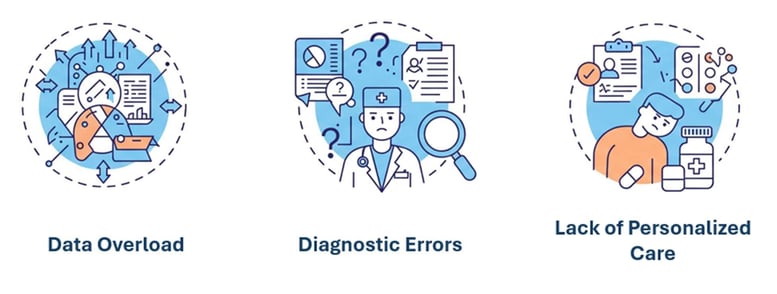
1. Data Overload
Modern online healthcare systems generate vast amounts of data daily, encompassing everything from electronic patient records to lab reports, imaging scans, and genomic data. While accumulated data has the potential to transform patient care, it can also increase the workload of healthcare providers and delay diagnosis and treatment times.
2. Diagnostic Errors
Diagnostic errors remain a significant problem, with estimates of misdiagnosis at around 5% and a higher rate of misdiagnosis in patients treated in hospital-operated settings. Diagnostic errors, misdiagnoses, or delayed diagnoses of patients.
3. Lack of Personalized Care
Never mind that somatic medicine remains to be considered a personalized approach. The onus of traditional treatments lies on a "one-size-fits-all" basis, which aptly excludes several factors based on genetic, biochemical, and lifestyle correlations specific to that patient. This "lack of personalization" concept may result in the unnecessary nature of the treatment and, hence, a less personal experience.
Agentic AI not only equips them to resolve these challenges but also provides precise, actionable, and uncommon insights, enabling them to take a stand for themselves in these areas.
How Agentic AI is Transforming Healthcare
What is Agentic AI?
Agentic AI fixed, predefined parameters. Such combinatorial systems create efficiency, precision, and flexibility, making them among the most valuable tools in complex sciences like healthcare.
Unlike some traditional AI tools or systems, Agentic AI systems are specifically designed to automatically and independently manage large datasets, assess this data, process changing situations, and evolve with minimal human supervision. They will perform tasks in specific situations that require precision, speed, and consistency.
Applications of AI in Healthcare
Agentic AI in Healthcare is a game-changer, transforming complex data into actionable insights that enable clinicians to devote their time to patient care rather than administrative tasks. Applications range from analyzing genomic data for individualized therapies to utilizing AI for medical imaging studies, facilitating early disease detection. The implications are vast and wide-ranging.
Specialised Agentic AI Systems in Healthcare
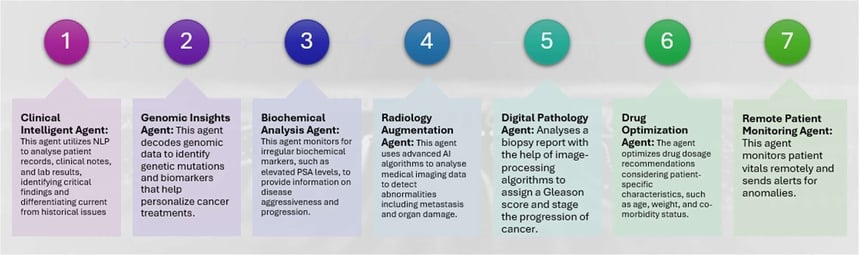
1. Clinical Intelligence Agent
An agent of this sort works with natural language processing (NLP) for examining patient records, clinical notes, and lab results, to identify critical findings and differentiate current issues from historical ones.
Scenario: In the emergency department, a Clinical Intelligence Agent could identify an alarming case of sepsis by interpreting real-time patient vitals, past medical history, and lab results. The swifter the identification, the quicker the doctor is able to initiate lifesaving treatment within that miraculous golden hour.
2. Genomic Insights Agent
This agent decodes genomic data to identify genetic mutations and biomarkers that help personalize cancer treatments.
Scenario: A Genomic Insights Agent at a cancer treatment center identified BRCA1 mutations in a breast cancer patient and provided oncologists with guidance on using these recommendations to target therapies and improve outcomes.
3. Biochemical Analysis Agent
The Patient Monitoring Agent provides information on the aggressiveness and progression of the disease by monitoring for irregular biochemical markers, such as elevated PSA levels.
Scenario: A urologist uses a Biomarker Agent to obtain measurements of fluctuating PSA levels in a prostate cancer patient, providing real-time data on the disease's progression, which can then be used to adjust treatment accordingly.
4. Radiology Augmentation Agent
This agent utilises advanced AI algorithms to analyse medical imaging data, detecting abnormalities such as metastasis and organ damage.
Scenario: A radiologist deploys a Radiology Augmentation Agent to interpret a patient's MRI scan, discovering early liver metastasis that was previously missed due to manual interpretation. This earlier recognition allows prompt intervention.
5. Digital Pathology Agent
Analyses a biopsy report with the help of image-processing algorithms to assign a Gleason score and stage the progression of cancer.
Scenario: The Digital Pathology Agent in the pathology lab studies prostate cancer biopsy slides and assigns a Gleason score and stage to the cancer in just a few minutes, allowing oncologists to provide a treatment rationale.
6. Drug Optimization Agent
This agent optimizes drug dosage recommendations considering patient-specific characteristics, such as age, weight, and co-morbidity status.
Scenario: In an ICU, the Drug Optimization Agent is programmed to administer an appropriate dosage of anticoagulant for a diabetic patient with heart problems, aiming to achieve the desired efficacy while minimizing unwanted side effects.
7. Remote Patient Monitoring Agent
This agent remotely monitors patient vitals and sends alerts for any anomalies.
Scenario: A remote patient monitoring agent has been implemented in a rural healthcare clinic to track patients' post-operative recovery. When the agent detects an irregular heart rate for a given patient, it alerts the medical team to prevent complications before they present.
The Benefits of Agentic AI in Healthcare
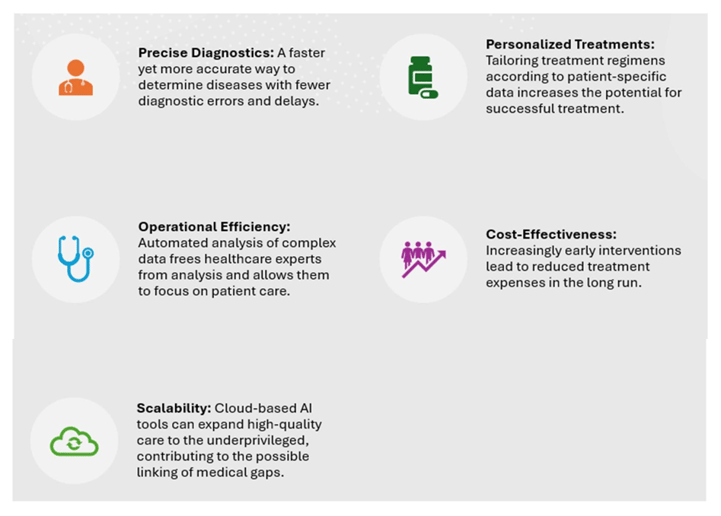
The integration of Agentic Artificial Intelligence offers innumerable advantages from which we are:
Challenges to Implementing Agentic AI in Healthcare
Despite its immense potential, the adoption of Agentic AI in healthcare is not without challenges:
- Privacy Concerns: Data Privacy and Security-As a near-immediate concern.
- Integration with Legacy Systems: Many healthcare institutions have shunned the adoption of computerized systems.
- Ethics: Addressing biases in algorithms and applying fairness to the treatment recommendations is critical.
- Regulatory Hurdles: Following convoluted regulations around the implementation of AI in healthcare requires almost tedious planning and cooperation.
The Future of Agentic AI in Healthcare
The future of healthcare lies in Agentic AI systems that can be seamlessly integrated. As technology advances to safeguard increasingly sophisticated treatment standards with the capability of being solved, alliances between AI developers, healthcare providers, and policymakers remain substantial to achieve equal access to AI-enabled solutions.
Appropriate innovation will work favorably to help the start-up and broader healthcare ecosystem maintain itself at a rational level, combining human intelligence and machine intelligence to achieve superb patient outcomes.
Sample Scenario: A Day in the Life of a Hospital with Agentic AI
Imagine a hospital where AI for Patient Engagement is implemented:
- Morning: A Clinical Intelligence Agent processes a patient's EHR for abnormal parameters suggesting acute kidney injury.
- Afternoon: A Radiology Augmentation Agent analyzes the CT scan result and suggests some early signs of kidney problems to confirm the diagnosis.
- Evening: A Biochemical Analysis Agent leaves the recommendation of adjusting medication regimes based on laboratory results.
The results included timely diagnosis, cost reduction in treatment, and increased patient satisfaction.
At early stages, the Agents can also work with human intervention to provide reliable results.
Conclusion
The development of Agentic AI is a game-changer, with the potential to transform the entire healthcare system. These systems were designed to enhance efficiency and eliminate diagnostic errors through personalized treatments, thereby acting as a bridge from data to actionable insights.
Is this a golden opportunity for us to unlock the vast potential of Agentic AI and reshape the future of healthcare?
Ready to explore the transformative power of Agentic AI for Healthcare? Partner with us to build innovative, secure, transparent, and trustworthy solutions for the future of healthcare.
Visit Coforge Quasar to know more.

Susmit Sil is a forward-thinking Enterprise Architect, AI CoE, Coforge Technologies. He has 20+ years of IT experience with strong technology leadership experience in Emerging Technologies i.e. Generative AI, Deep Learning, NLP, Speech, Conversational AI, Responsible AI, Blockchain.
Related reads



About Coforge
We are a global digital services and solutions provider, who leverage emerging technologies and deep domain expertise to deliver real-world business impact for our clients. A focus on very select industries, a detailed understanding of the underlying processes of those industries, and partnerships with leading platforms provide us with a distinct perspective. We lead with our product engineering approach and leverage Cloud, Data, Integration, and Automation technologies to transform client businesses into intelligent, high-growth enterprises. Our proprietary platforms power critical business processes across our core verticals. We are located in 23 countries with 30 delivery centers across nine countries.