

By 2027, over 75% of large logistics enterprises will invest in AI-driven operational optimization to counter rising fuel costs, capacity constraints, and margin pressures – Gartner
Global AI spending in supply chain and logistics to grow at a double-digit CAGR over the decade, with automation and predictive optimization as the leading investment priorities - IDC
Yet despite this acceleration, industry studies estimate that cargo operators across air, sea, and road continue to use 10–25% of their load space on average.
In an industry where margins are razor-thin and fuel accounts for one of the largest operating expenses, that inefficiency is not marginal; it is massive. For a large global freight operator, even a 5% improvement in load optimization can translate into tens of millions of dollars annually in cost savings and capacity gains. The hidden cost of not optimizing space is not just unused cubic meters, it is wasted fuel, excess carbon emissions, higher per-unit transport costs, delayed deliveries, and lost competitive advantage.
The cargo and logistics industry is now at a turning point. As global trade expands and supply chains become more volatile, the ability to intelligently use every cubic inch of cargo space is no longer an operational enhancement; it is a strategic imperative.
Operational Challenges That Cap Cargo Performance
Cargo operators across air freight, maritime shipping, trucking, and warehousing face a common challenge: dynamic constraints in a static planning world.
Load planning remains heavily dependent on human expertise. Teams manually evaluate weight distribution, fragility requirements, container dimensions, regulatory constraints, and route-specific limitations. When new shipments are added or delays occur, recalculations are often reactive and suboptimal.
Traditional rule-based systems and static 3D modeling tools cannot adapt dynamically. They struggle to:
- Recalculate optimal loads in real time
- Incorporate changing weather conditions or route restrictions
- Optimize for both weight balance and volume efficiency simultaneously
- Integrate real-time IoT sensor data
The result is persistent underutilization—aircraft flying with empty space, containers partially filled, trucks operating below optimal capacity, and warehouses storing inefficiently.
Over time, this inefficiency compounds. Higher per-unit costs reduce pricing flexibility. Fuel waste increases emissions. Turnaround times expand. Service reliability declines.
AI as the Cognitive Layer of Cargo Operations
AI introduces something traditional systems never could: cognitive automation.
Instead of relying on fixed logic, AI systems continuously learn from historical load patterns, shipment variability, weather disruptions, and route performance. They dynamically simulate millions of load configurations in seconds, identifying the optimal balance among space, weight, fragility, priority, and fuel efficiency.
The transformation rests on several key capabilities:
Machine Learning analyzes historical data to predict optimal configurations and future cargo demand.
Computer Vision interprets cargo images to determine dimensions, stacking feasibility, and risk factors—reducing manual inspection and estimation errors.
Reinforcement Learning simulates packing and routing strategies, adapting in real time as constraints change.
Predictive Analytics forecasts space requirements and distribution patterns across routes.
Digital Twins create virtual 3D environments where cargo loading scenarios can be tested before execution—reducing trial-and-error in the physical world.
Together, these technologies move cargo operations from static planning to adaptive intelligence.
From Descriptive to Autonomous: The Architecture Shift
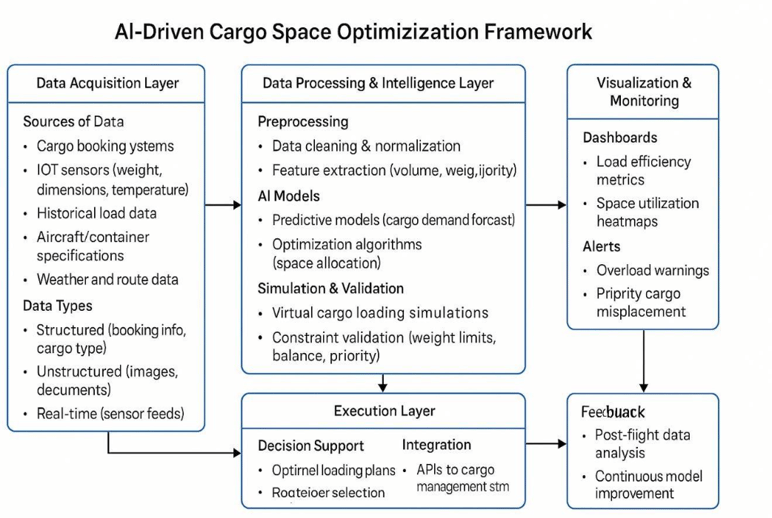
AI-driven cargo space optimization operates across multiple layers.
At the data layer, information flows in from booking systems, IoT sensors (weight, dimensions, temperature), aircraft or container specifications, route and weather data, and historical load records.
At the intelligence layer, data is cleaned, normalized, and enriched. AI models forecast demand, calculate optimal space allocation, and simulate loading scenarios while validating regulatory and safety constraints.
At the execution layer, optimal loading plans are integrated via APIs into cargo management systems; dashboards provide real-time visibility; and post-operations feedback loops continuously refine model performance.
This architecture transforms space optimization into a living system—one that improves with every shipment.
Measurable Gains Across Modes
AI-driven optimization is already demonstrating double-digit impact across logistics domains.
In air cargo, operators have reported up to 18% improvement in load utilization and a 70% reduction in planning time.
In maritime shipping, container utilization has improved by over 12%, with turnaround time reductions approaching 15%.
In trucking operations, AI-based optimization has increased delivery capacity by as much as 25%, while reducing route times significantly.
In warehousing, digital twin–based layout optimization has driven up to 35% improvement in storage capacity and faster retrieval cycles.
Beyond cost efficiency, sustainability benefits are substantial. Fewer trips, optimized weight distribution, and smarter routing directly reduce fuel consumption and emissions, critical as regulators globally tighten environmental standards.
The Hidden Cost of Delay
Despite proven benefits, many logistics operators remain cautious, often due to legacy system complexity or integration challenges.
But the cost of delay is rising.
Fuel volatility continues to pressure margins. Carbon taxation frameworks are expanding. Customers expect faster delivery cycles. Capacity constraints intensify during peak demand.
Without intelligent space optimization, operators absorb higher per-unit costs and miss revenue opportunities tied to improved asset utilization.
In an industry projected to exceed $15 trillion globally by 2030, marginal gains in operational efficiency compound into competitive differentiation. The organizations that optimize early will widen the cost gap.
A Practical Path to Adoption
The transition does not require a disruptive overhaul.
Successful implementations typically follow four stages:
Assessment: analyzing current utilization patterns and establishing baseline inefficiencies.
Pilot Deployment: implementing AI for a specific cargo type, route, or warehouse to validate impact.
Scaling: expanding optimization across transport modes and facilities while integrating federated learning models.
Continuous Learning: embedding feedback loops, retraining models, and refining decisions as conditions evolve.
Security, explainability, and governance remain essential. AI systems must integrate securely with enterprise platforms, maintain audit trails, and ensure transparency in automated decision-making.
Toward Fully Autonomous Cargo Ecosystems
The next phase of evolution moves from optimization to autonomy.
As digital twins mature and reinforcement learning improves, cargo systems will shift toward fully autonomous orchestration, where load decisions, route adjustments, and capacity allocation occur dynamically with minimal human intervention.
Every cubic inch of cargo space will become an intelligent asset.
How Coforge Enables AI-Driven Logistics Transformation
Coforge partners with global logistics and transportation enterprises to design and deploy AI-native optimization architectures. By combining domain expertise in air cargo, maritime systems, and multimodal logistics with advanced AI engineering, Coforge enables organizations to move from manual load planning to autonomous, data-driven decision systems.
From digital twin implementation and IoT integration to reinforcement learning models and real-time orchestration platforms, Coforge helps operators unlock measurable improvements in utilization, cost efficiency, and sustainability performance, without disrupting mission-critical systems.
The Future of Cargo Is Intelligent
AI-powered space optimization is not a marginal enhancement; it is a structural shift.
In a world of tightening margins, rising carbon accountability, and growing delivery expectations, the intelligent use of space will separate efficient operators from laggards.
The future of cargo logistics will not be defined by bigger fleets or larger warehouses, but by smarter decisions, executed in real time.
The time to optimize is now.

Jatin Dhawan is a Test Architect at Coforge specializing in Quality Engineering and digital assurance for the Travel, Transportation & Hospitality (TTH) industry, with experience across passenger services, cargo, crew, and large-scale system integrations for global airlines. He has led end-to-end QA transformations, including PSS migrations and complex integrations, ensuring reliability and seamless delivery. At Coforge, he drives capability development through structured learning programs across airline domains. Jatin also contributes to automation frameworks, accessibility initiatives, and aviation-focused thought leadership. He has hands-on expertise across functional, automation, API, and data-driven testing using modern toolsets. He actively supports innovation and knowledge-sharing initiatives, strengthening domain excellence within the organization.
Related reads



About Coforge
We are a global digital services and solutions provider, who leverage emerging technologies and deep domain expertise to deliver real-world business impact for our clients. A focus on very select industries, a detailed understanding of the underlying processes of those industries, and partnerships with leading platforms provide us with a distinct perspective. We lead with our product engineering approach and leverage Cloud, Data, Integration, and Automation technologies to transform client businesses into intelligent, high-growth enterprises. Our proprietary platforms power critical business processes across our core verticals. We are located in 23 countries with 30 delivery centers across nine countries.